Documentation Index
Fetch the complete documentation index at: https://docs.seersearch.com/llms.txt
Use this file to discover all available pages before exploring further.
Make your retrieval performance measurable. Set SLOs, track trends over time, and catch regressions before they impact users, all with low-overhead sampling.
Prerequisites: You’ve completed the Quickstart and understand the Context & Event Schema.
What You Get
- Evaluator-defined Recall on unlabeled traffic (flag queries with
recall < 1.0)
- Precision (proxy): Ratio of supporting passages to total context (detects context bloat)
- F1 & nDCG derived from recall + precision
- P95 Latency tracking for evaluation time
- Trend charts to catch drift over time
- Environment filtering to compare prod vs staging vs dev
- Evaluator Accuracy (when ground truth is provided)
Enable Monitoring
Control volume with sample_rate to manage costs.
from seer import SeerClient
import os
client = SeerClient()
def retrieve(query: str) -> list[dict]:
# your real retriever here
return [{"text": "...", "score": 0.9}]
def handle_request(query: str):
context = retrieve(query)
client.log(
task=query,
context=context,
metadata={
"env": os.getenv("APP_ENV", "prod"),
"feature_flag": "retrieval-v1",
},
sample_rate=0.10, # 10% of calls are evaluated
)
import { SeerClient } from '@seer/sdk';
const client = new SeerClient();
function retrieve(query: string) {
// your real retriever here
return [{ text: "...", score: 0.9 }];
}
function handleRequest(query: string) {
const context = retrieve(query);
client.log({
task: query,
context: context,
metadata: {
env: process.env.APP_ENV ?? "prod",
feature_flag: "retrieval-v1",
},
sample_rate: 0.10, // 10% of calls are evaluated
});
}
Sampling Guidance
| Use Case | Recommended sample_rate |
|---|
| Change testing | 1.0 (100%) for test queries |
| High-volume production | 0.05 - 0.10 (5-10%) |
| Low-volume or critical | 0.25 - 0.50 (25-50%) |
| Debugging | 1.0 temporarily |
Smart Sampling with Decorator
Use the decorator with dynamic sampling based on metadata:
from seer import seer_trace
import os
@seer_trace(
task_arg="query",
context_from_return=True,
metadata={"env": os.getenv("APP_ENV", "prod")},
sample_rate=0.10, # 10% sampling
)
def retrieve(query: str) -> list[dict]:
return [{"text": "...", "score": 0.9}]
# Logs automatically when called
results = retrieve("user question...")
The Monitoring Dashboard
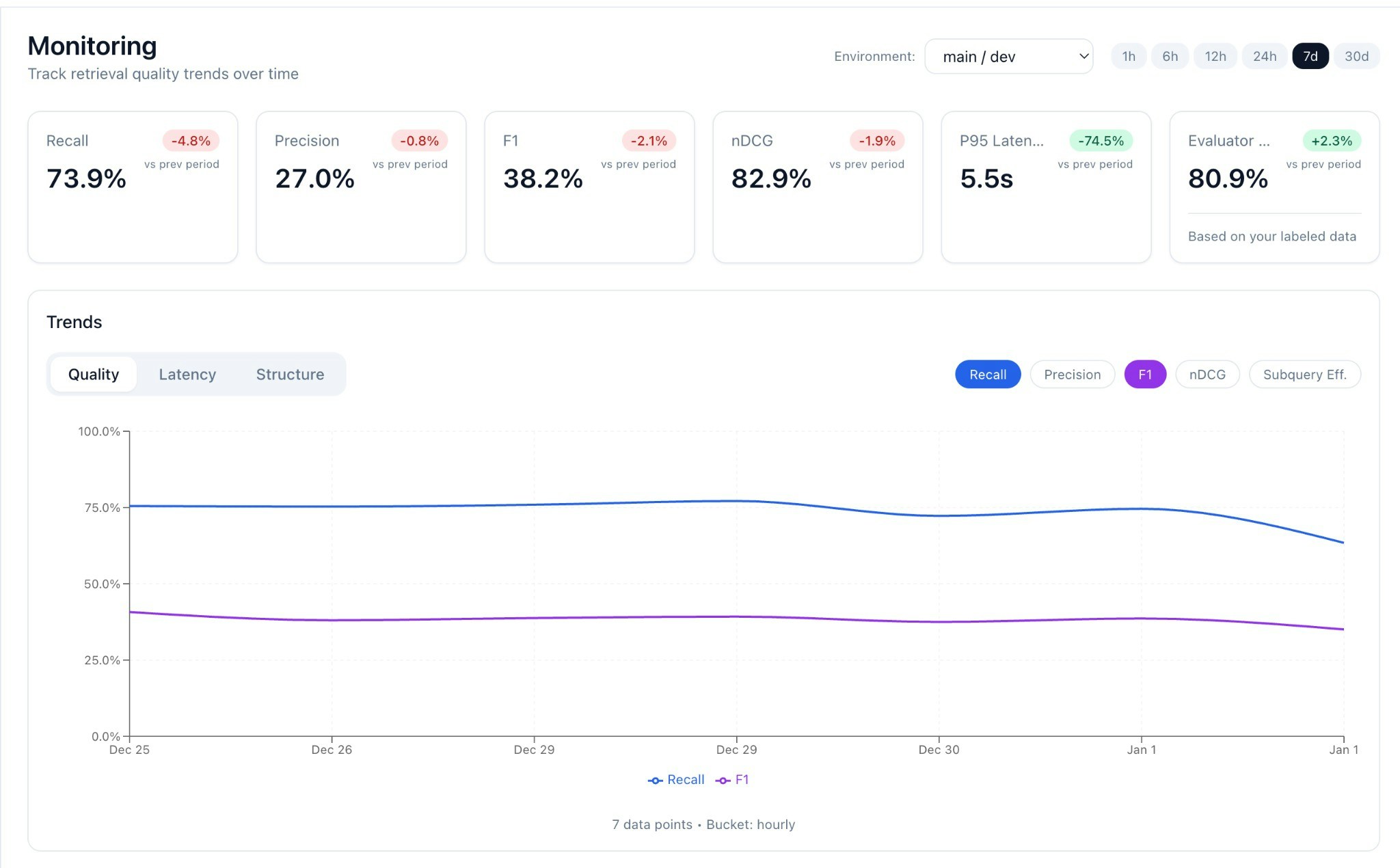
KPI Cards
At the top, you’ll see summary metrics for the selected period:
| Metric | Description |
|---|
| Recall | Average fraction of requirements covered |
| Precision | Average fraction of supporting documents |
| F1 | Harmonic mean of recall and precision |
| nDCG | Ranking quality (if scores provided) |
| P95 Latency | 95th percentile evaluation time |
| Evaluator Accuracy | F1 against your ground truth (shown when gold data exists) |
Each card shows delta vs. previous period (e.g., +2.1% week-over-week).
Trend Charts
The trend chart has three tabs:
| Tab | Metrics | Scale |
|---|
| Quality | Recall, Precision, F1, nDCG, Subquery Effectiveness | 0-100% |
| Latency | P50, P95 evaluation latency | milliseconds |
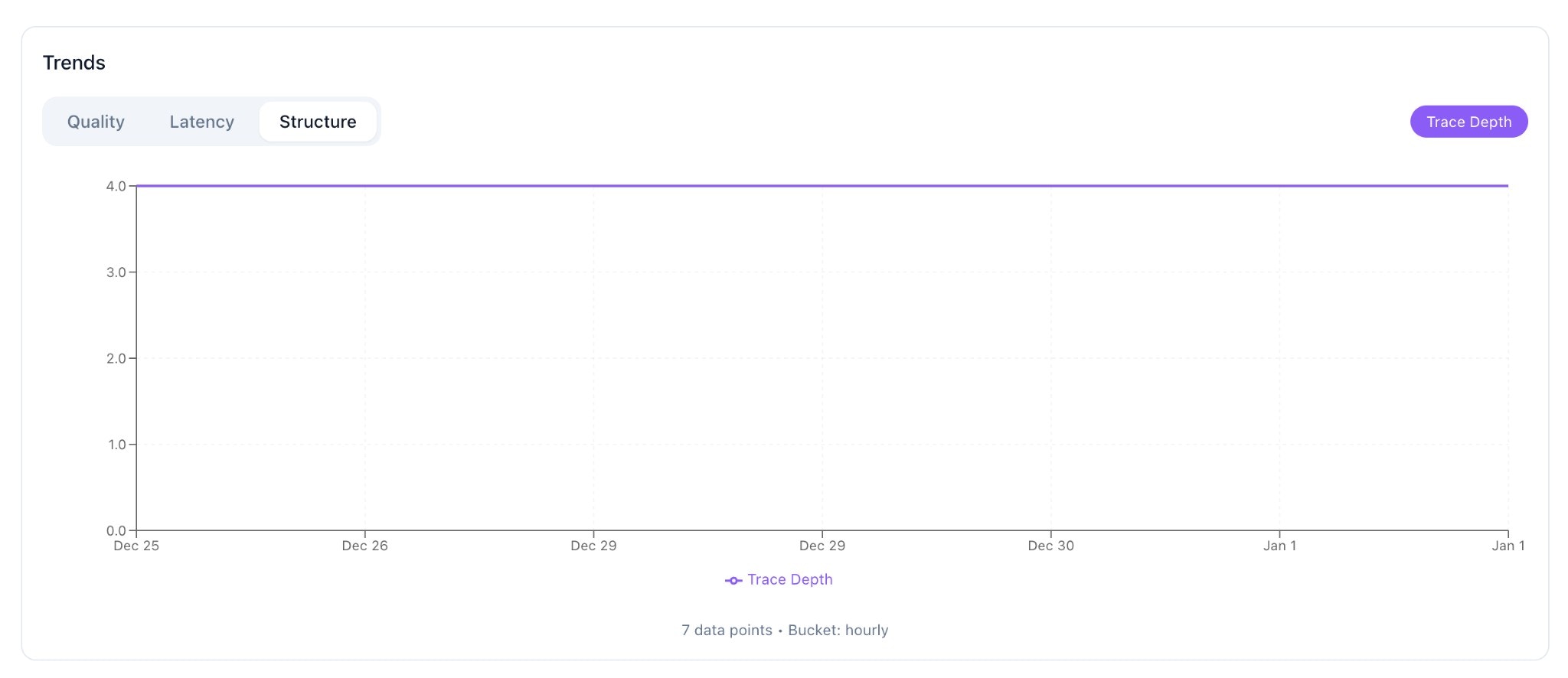
| Structure | Trace Depth (multi-hop only) | count |
Toggle individual metrics on/off to focus your analysis.
Latency Tab
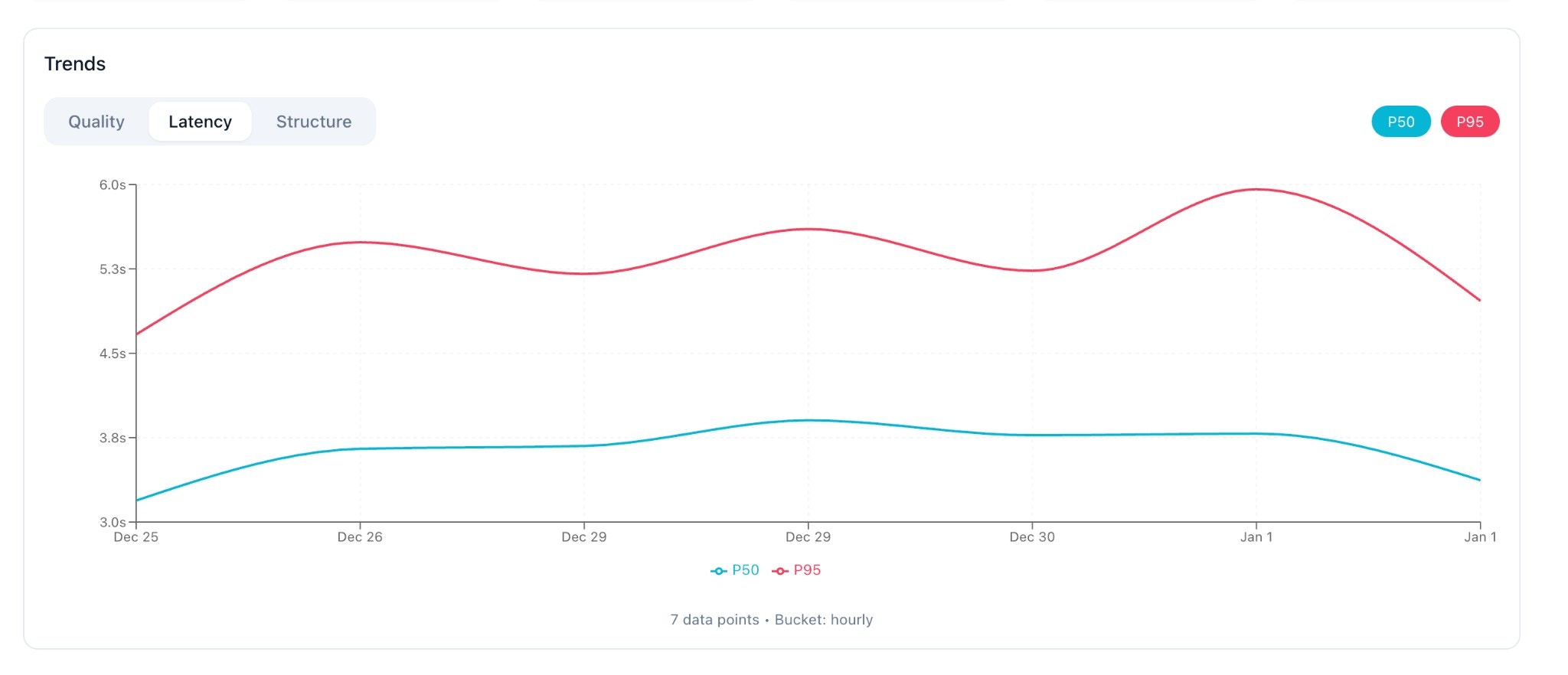
Track evaluation latency percentiles over time. Useful for detecting slow-downs or backend issues.
Structure Tab
For multi-hop retrieval, track trace depth to understand query complexity trends.
Filtering
Filter your view using:
- Environment: Select a specific env (prod, staging, dev)
- Period: 24 hours, 7 days, or 30 days
We’re adding support for filtering by feature_flag and custom metadata fields directly in the Monitoring dashboard. For now, use the A/B Testing page to compare feature flags.
Cost Management
- Sampling keeps evaluation cost predictable. Start at
0.05 and tune up if needed.
- SDK batching minimizes request overhead (events are queued and sent in batches).
- Async mode (default) — logging never blocks your request path.
Estimated Costs
| Monthly Evaluations | Seer Cost |
|---|
| 100k | ~$16-20 |
| 1M | ~$160-200 |
| 10M | ~$1,600-2,000 |
Privacy Considerations
- You control what you send. If passages are sensitive, include only what’s needed for evaluation.
- Use
metadata to tag records with access boundaries (e.g., collection, tenant_id) for future filtering.
- Consider truncating or summarizing very long passages.
Example: Tier-Based Sampling
from seer import SeerClient
client = SeerClient()
def handle_request(query: str, user_tier: str):
context = retrieve(query)
# Higher sampling for enterprise customers
rate = 0.25 if user_tier == "enterprise" else 0.05
client.log(
task=query,
context=context,
metadata={
"env": "prod",
"user_tier": user_tier,
"feature_flag": "retrieval-v1",
},
sample_rate=rate,
)
See Also